Greenwich home of
Cutty
|
|
|
Location 5 miles (8 kilometres)
south east of
Transport Greenwich Station (trains from
Things to see: Cutty
|
||
|
If you like what we are doing please follow one or more of the links |
||
|
|
||
| Background | ||
|
Greenwich was established as a
little fishing port on the
Meanwhile,
The old village centre of
Croom's Hill, the finest street in modern Regency rebuilding
In the late 18th and early 19th centuries elegant streets
were added to the west of the village below Point Hill, and in the 1830s the
old congested village centre was rebuilt in flamboyant Regency style.
Following that the building of the pier for steamboats in 1836 and the
opening of the railway station in 1838 (the
Today its main attractions are concerned with
its maritime past and its role in the development of the world's time zones.
The two are related since the Old Royal Observatory in
|
||
| GREENWICH WALK | Top | |
|
Start and finish at various points I have attempted to set the start and finish at convenient points, it is unwise to drive in as parking is a nightmare, and limited at best, so
Walk 1. Walk 2. If you arrive on the DLR Via Stratford / Fenchurch Street at Cutty Sark or by bus although you start part way through walk 1, you rejoin and return here. |
||
| Walk 1: start here: | ||
|
Come out of Greenwich Station onto the forecourt. Directly opposite across the High Road is Queen Elizabeth's College, the almshouse founded by historian and local landowner William Lambarde in 1574 and rebuilt by the livered Drapers' Company, who now run it, in 1817. Turn right on the High Road, walk on and take the first right into Straightsmouth. Follow this road under the railway bridge and then round to the right.
As you approach the village centre, you get a
fine view of the parish
church of
Alfege the 29th Archbishop of
Canterbury ,
probably would be lost to time but an invasion by Viking
raiders captured the Archbishop of Canterbury Alfege, and brought him
hostage to their camp at
13th century
18th century
Go straight
on into Churchfields. At the end look left along Roan Street and you will
see the early 19th-century master's house of the Roan School, one of
Greenwich's old charity schools founded in the 1670s by John Roan, a local
man and Yeoman of Harriers to Charles I. The original school site is marked
by a plaque. straight across
Left is the river and right is the park, go
straight over
Please note the odd and ungrammatical trader's warning
above the arch as you pass out into College Approach, to
the right are the gates of the old |
Top | |
| Old Royal Naval College | Top | |
|
On the site of the
The 17th century building was replaced by two
new buildings: the early-17th-century Queen's House, the first elegant
classical domestic building in
Begun for Charles II by architect John Webb, it
was completed by Christopher Wren, Nicholas Hawksmoor and John Vanburgh as
the The first block on the right was the one intended by Charles II to form part of a new palace. The other buildings were all completed later once the decision had been taken to build a seamen's home instead. From the centre there is a fine view of the Queen's House and behind it, up on the hill, the 17th-century Royal Observatory.
From the early 1800s, the Queen's House,
designed by Inigo Jones, housed the
The hospital closed in 1869 and four years later
the Royal
The old Hospital, is currently
open and you can see this fabulous Painted Hall with its impressive
paintings on the walls, ceiling, columns just about everywhere, the
paintings are a history lesson in it’s self, with all the trappings of
intrigue mystery and backbiting, this is a MUST SEE. This was the dining
room for the old sailors simply unmissable, and Opposite is the hospitals
church, another worthwhile visit, take care not to miss the cobbled yard
right next to the hall, you can imagine all the old sailors parading here. |
||
| Meridian | Top | |
|
Between the painted hall and the church building look south and up the hill, you will see the Royal Observatory, The Observatory is both the home of GMT (Greenwich Mean Time) and the dividing point where longditude starts The ball on top, originally installed in 1831, drops at 1pm precisely to signal the correct time for ships passing down the Thames, but at five minutes to 1pm the ball rises slowly and completes it’s journey at about 2 minutes to 1, you can imagine all the ships masters along the Thames, raising their telescopes and shielding their eyes against the sun, and checking their watches, remember they had a clear view, with few buildings in those days .
Retracing our steps back into College Approach
and then right, following
Originally the street ran right
down to the riverside past the Ship Hotel on the right. Having been heavily
bombed during World War II, as much of the surrounding area was, ( if you
look carefully as you walk around london, you will pick up on old buildings
next to perhaps 50’s and 60’s tacky reconstructions, now when I was a boy a
bus ride would show you (from the top deck) all the “bomb site’s” which
London wore with pride, many of which were not rebuilt on for quite a few
years. Until the poorly trained planners with little insight took over) |
||
|
Foot tunnel
This area was left open to form
today's esplanade. Right by the river is the domed entrance to the Greenwich
Foot Tunnel, opened in 1902 to allow workers to reach the docks on the other
side of the river, (workers further down had the free ferry at
Woolwich) the tunnel is a spooky place it if, you are unlucky to be walking
through it on your own…. If you take the manned lift down there is an
inscription as to it's cost which is claimed to be £125,000 and lined with
some 200,000 glazed tiles, when you are across, at Island Gardens (DLR
station close by) at the other end of the Foot Tunnel on the north side, it
is called the Isle of Dogs and opens to a small park, ideal spot for a
packed lunch with spectacular views over Greenwich, and you will see close
to here another part of the London Marathon course here as well, at about
mile 17. |
||
| Walk 2: start here, if you join us at the DLR station) | Top | |
|
when you get to the end of the walk, follow on back to here, as from walk
1 |
||
|
Looking toward the new dockland's over the river
Thames, on the left is Gipsy Moth IV, the first boat to be sailed round the
world single-handed (by Sir Francis Chichester in 1966—67) he was Knighted
by Queen Elizabeth here, and to the right is one of the great sights of
maritime
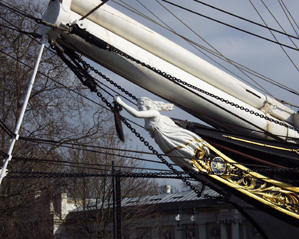
Walk toward the side of the Cutty Sark, turn
right under its bowsprit look up and see the figure head see below for more
details….* and continue past the pier entrance along the riverside
walk. Ahead is a fine view of the Blackwall peninsula, the site of the Dome
Millennium exhibition and the new
port of
On the right you pass the granite monument put
up in 1853 to the memory of Frenchman Joseph Bellot who lost his life
attempting to discover the fate of Sir John Franklin's doomed
Beyond the College turn right by the Trafalgar Tavern stop and have a rest here this was a favourite with diners of Thames whitebait in the last century, built in 1837 and up until 1883 it used to hold Ministerial "whitebait" dinners at the end of each session of Parliament. |
||
|
The Trafalgar Tavern |
Top | |
|
Famous visitors to the tavern have included authors Charles Dickens and Wilkie Collins. walk along Park Row, past a row of terrace houses, crossing a major road (Romney Road) and continuing straight ahead almost to the river front. Just before the riverfront, stop at the entrance to Crane Street (on the right) turn right along Crane Street and stop in front of the white building on the left fable has it Crane Street is so-called because ships used to be unloaded by cranes along it. this takes you into High Bridge and High Bridge brings you in turn to the Trinity Hospital almshouse’s. Trinity Hospital and the Cutty Sark Tavern, Trinity Hospital.
Trinity Hospital was founded in 1613 by the Earl
of Northampton to house 20 poor, retired men. His tomb is in the chapel.
Carry on under the power station gantry and turn
right along
There used to be two fairs held at Greenwich : the Easter fair and Whitsun fair. The Easter fair is mentioned in Thackeray's Sketches and Travels in London. Dickens also describes the fair in Sketches by Boz, calling it "a sort of rash; a three days' fever which cools the blood for six months afterwards".
When you get to The row of houses here — Nos. 36—33 incorporating The Chantry — was originally built for the Admiral Commissioner of the Naval Asylum (school). The westernmost section at the end of Park Vista now serves as St Alfege's vicarage.
Beyond the vicarage, turn left into the park and then right onto the path
beside the Queen's House and the |
Top | |
| National Maritime Museum | Top | |
|
Britain
's seafaring history, all displayed in an impressive
museum. exhibits which change on a regular basis, but include exploration
and discovery, Nelson, 20th century sea power, trade and empire, passenger
shipping, maritime London, costume, art and the sea and the future of the
sea.
Up on the hill, where Duke Humphrey's Tower used
to stand, is the Observatory we saw it earlier from between the painted
hall
We can walk up here to visit: |
||
| The Greenwich Royal Observatory | Top | |
|
The Greenwich Royal Observatory was founded by
King Charles II to study astronomy and to fix longitude; see the bit about
the Prime Meridian. The oldest building comprising the observatory is
Flamsteed House. It was built in 1675, with Sir Christopher Wren as the
architect. It was built as a home for the first Astronomer Royal, John
Flamsteed. He lived in the ground floor, and worked in the Octagon room
above until his death in 1719. His successor in the office was Edmund
Halley, famous for the comet that bears his name. Later Astronomers Royal
lived there until 1948. The time ball on the roof was first erected in 1833,
providing the first public time signal. At five minutes to
Other
buildings include the
The buildings now house many of
the instruments used in the past, plus a collection of time-telling devices
from sun-dials to atomic clocks. Among the exhibits is a 28 inch refractor
telescope, one of the largest in the world. It was originally moved to
Hurstmonceux, but was returned on the tercentenary of the Observatory. It is
still used for research and teaching. |
||
| Back down | Top | |
|
At the end of the tarmac walk, carry on past St
Mary's Gate and then branch left past the Visitor Centre and the herb
garden. Exit from the park at Circus Gate and go straight over Croom's Hill
into Gloucester Circus, keeping to the left-hand side of the central garden.
You are now in
Leave the Circus at the far end and turn left up
Royal Hill, named after its main developer, Robert Royal. Opposite the
Prince Albert pub, (another place to stop) turn left into Hyde Vale and walk
up the hill past some rather nice houses, particularly the villas on the
right dating from the 1830s. onward turn right into Diamond Terrace. Follow
this round the side of the hill and then, at the end, turn left up steep
Point Hill. Opposite
Cross straight over the open space Point Hill and continue on into West Grove.
The busy road on the right is the main road
across Blackheath to
Croom's Hill begins at the intersection of
Below the Manor House is a green with a Catholic church and a fine presbytery next door. Downhill from the church is the oldest house in Groom's Hill, Heathgate House, built about 1635. Just further on you come to another old building, this is the roadside gazebo built in 1672 overlooking the park. The gazebo belongs to The Grange, an 18th-century house standing behind the gazebo wall in its own grounds.
There are some late 18th-century houses in and
around
|
||
|
The
|
Top | |
|
The two Georgian houses, dating from the 1720s,
are home to the most incredible collection of fans in the world. The only
Museum of its kind, the
On the right the Spread Eagle on the corner of
Carry on past the Spread Eagle down
|
||
|
*Cutty
Note: Currently undergoing refurbishment after a fire |
Top | |
|
On the afternoon of
Although
her early years under her first master, Captain George Moodie, saw some
sterling performances, fate was to thwart her owner's hopes of glory in the
tea trade: in the very same year of her launching, the Suez Canal was
opened, allowing steamers to reach the Far East via the Mediterranean, a
shorter and quicker route not accessible to sailing ships, whose freights
eventually fell so much that the tea trade was no longer profitable. So
Cutty
For several years, she was forced to seek cargos where she could get them, and it was not until 1885 that she began the second (and more illustrious) stage of her career. The ship's
heyday was in the Australian wool trade, from 1885 to 1895. Here was a
virtuoso mariner who 'played' the Cutty Sark like the responsive
'instrument' she was: she repeatedly made the fastest passage home from
She
laboured steadily for her new masters for almost three more decades ~
regularly trading between
Dismasted
and damaged in a storm in the
In 1922,
at which time she underwent a refit at London's Surrey Docks. This gale was 'fateful' because she was spotted there by Captain Wilfred Dowman, a Cornish mariner who, as an apprentice seaman back in 1894, had seen her 'at top speed' with full sail and had never forgotten that breathtaking sight. She was now very much dilapidated, so Captain Dowman made his move ~ he approached her Portuguese owners, bought her for the sum of £3,750 and had her restored, re-rigged and flying the 'Red Duster' once again. On Capt.
Dowman's death in 1938, his widow presented the newly restored clipper to
the
Lengthy
discussions ensued over her future, which ultimately led to her being towed
to a mooring off
Since her official opening in 1957 by HM The Queen, Cutty Sark has been visited by over 15 million people from all over the world, As a small boy, I went aboard soon after the opening, and it still has a magical feel, especially below decks when your imagination takes over. Now, 137 years after her keel was laid, and long outliving a normal life expectancy of just 30 years for a ship of this type, she is still an amazing sight, delighting her visitors. If you have time take a tour of her decks and support the restoration and up keep of this beautiful vessel. |
Top | |
|
Remember this free site is
sponsored by and paid for by advertising, |
||
| ©Self Guide London 2010 | ||